

Wagga Wagga Net Zero Emission Community Roadmap | Initial Community Consultation
In December 2022 and January and February 2023, Wagga Wagga City Council is undertaking an initial community consultation in the process of writing the Wagga Wagga Community Net Zero Emissions Roadmap.
Wagga Wagga City Council has committed to:

endorse an interim community net zero emissions target of 50% reduction in community emissions by 2030 and net zero by 2050.
develop a roadmap that outlines Council’s role in the community achieving both the 2030 and 2050 net zero emissions targets.
In December 2022 and January and February 2023, Wagga Wagga City Council is undertaking an initial community consultation in the process of writing the Wagga Wagga Community Net Zero Emissions Roadmap. The Roadmap will be a document that will be guide the Wagga Wagga LGA to be increasingly climate friendly and will be used for reporting.
The following survey forms part of the community consultation and is available to all local community members. The survey closes on Thursday 23rd February.
Applications for Farmer of the Year Awards are now open
Applications for Farmer of the Year Awards are now open, including the Rural Community Leader of the Year and Young Farmer of the Year.

Applications for Farmer of the Year Awards are now open, including the Rural Community Leader of the Year and Young Farmer of the Year.
Nominations are open to individuals and families involved in farming enterprises or rural communities.
Entrants can nominate themselves or be nominated by a third party.
Award winners will take part in a Leadership Program supported by the Department of Agriculture, Fisheries and Forestry. This Major Prize, a one-day workshop aimed at leadership development within the agricultural industry, allows Award winners to develop their leadership capacity, grow industry networks and build their communication skills to represent the bright future of the industry.
The 2023 Award winners will be announced at an exclusive event at Parliament House in Canberra during June, incorporating a networking event, and a live outside broadcast of ABC Rural’s nationwide Country Hour radio program.
Nominations close on Tuesday 28 February 2023.
Regional labour markets hit record growth - but still can't meet job demand
Growth in the regional labour force surpassed the previous record levels of the mining construction boom a decade ago to hit 3.3 percent in the December 2022 quarter, according to the latest figures released by the Regional Australia Institute (RAI).

Growth in the regional labour force surpassed the previous record levels of the mining construction boom a decade ago to hit 3.3 percent in the December 2022 quarter, according to the latest figures released by the Regional Australia Institute (RAI).
However, labour market conditions in regional Australia remain tight, with the participation rate at its highest in more than 30 years, at 71.4 percent in December.
“Overall, regional economies and labour markets continue to outperform metropolitan markets under these much tighter conditions. In fact, we continue to see historically significant milestones reached that have set regions apart,” Liz Ritchie said.
“Despite the fact that regional people are keen and engaged to work, and population continues to grow, ultimately, we still need more people to meet this historic demand on the labour market.
“The number of jobs advertised in regional Australia in October 2022 was a record peak of 94,100 roles. While vacancies pulled back down to a little under 81,000 in December, this is still nearly a 100 percent increase on pre-pandemic levels.
“The figures for our metropolitan cities tell a different story, where job vacancy growth halted abruptly in February 2022 and recorded only one third of the growth rate experienced in regional Australia.
“Regional unemployment has been tracking lower than metropolitan unemployment over the last two years, hitting a new historic low of 2.8 percent in November and averaging 3.0 percent to round out the final quarter of 2022. Historically, the reverse has been true,” Ms Ritchie said.
In the month of December, demand for labour was highest in regional Queensland with more than 23,800 positions advertised. This is up 17.5 percent on the year earlier.
New South Wales was only slightly lower with 23,200 roles. Meanwhile, regional South Australia saw a 15.3 percent increase in annual job in vacancies. Regional Victoria recorded a 9.8 percent annual increase, with Western Australia just 2 percent – slightly lower than the 3 percent increase for mainland capital cities.
The five regions with the largest annual jumps in job vacancies for December 2022 were:
· Yorke Peninsula and Clare Valley, SA – Up by 33%
· Central Queensland – up by 28.8%
· Outback Queensland – up by 25.4 %
· Tamworth and North West NSW – up by 25.3%
· Blue Mountains, Bathurst and Central West NSW – up by 20.1%
To ensure Australia’s regional workforce is ‘fit-for-purpose’ in the future, the RAI has identified Jobs and Skills as one of the 5 key pillars in its Regionalisation Ambition 2032 – A Framework to Rebalance the Nation.
To achieve the goal within the Jobs and Skills pillar, the Regionalisation Ambition 2032 sets out the following targets:
By 2032:
Reduce the recruitment difficulty in regional Australia from 77% today to below 40%.
Increase the share of skilled workers employed in regional Australia from 73% as at May 2022 to 80% of the regional workforce.
Increase the Year 12 school attainment rate of young people in regional Australia from an average of 65% today to 75% or above.
Boost post-school qualification completion in regional Australia to 65% or above from 57% as at May 2021.
For a full copy of the RAI’s Regional Labour Market Update – December Quarter 2022, please click here.
The RAI will launch its first Annual Regional Labour Market Report at its Regions Rising event in Bunbury, Western Australia, on Friday 10 March.
Griffith is Home to Australia's Best Street Art Laneway Experience
An unobtrusive laneway that parallels Griffith’s main thoroughfare has been named as the best street art laneway experience in Australia.
An unobtrusive laneway that parallels Griffith’s main thoroughfare has been named as the best street art laneway experience in Australia.
Banna Lane has received the Gold gong for Best Street Art Laneway at the 2022 Australian Street Art Awards announced from Queensland’s Sunshine Coast last night.
Banna Lane nudged out Austin Lane – the birthplace of the Darwin Street Art festival, which took the Silver Award, and Bidencopes Lane in the heart of Hobart CBD, which secured the Bronze Award.
The Australian Street Art Awards, a tourism awards for public art program, encourage Australians to explore the world-class street and public art that is freely accessible all year round and found in every corner of the country.
Banna Lane runs for about a kilometre and boasts 19 pieces of public artwork produced by some of Australia's best and emerging artists. The styles are varied, making the lane way diverse, capturing the many aspects of life in Griffith. They include Wiradjuri, typography, abstract, photorealism, graphic and illustrative.
Awards Director Liz Rivers said, “This unique laneway contributes significantly to making Australia a more vibrant, creative and interesting country – somewhere visitors want to explore more keenly.”
“Smart communities promote their outdoor art, as a unique landmark – an attraction that visitors can see in only place, and that makes their destination immediately identifiable, highly attractive and a drawcard for art-loving tourists,” Ms Rivers said.
“Investing in outdoor art as an attraction mechanism also makes economic sense as art is typically less expensive to create than more traditional tourism attractions while the pay-off is handsome,” she said.
Domestic arts tourists are high value visitors – they stay almost one-and-a-half times longer and spend about one-and-a-half times more per day than domestic tourists overall, according to an Australia Council for the Arts’ Domestic Art Tourism: Connecting the Country Report.
In commenting on Banna Lane’s win, the judges congratulated the organisers of the Banna Lane Festival for ensuring new artwork is produced annually to promote return visitation.
“We love how artists are required to create a connection to the city of Griffith through the subject of their artwork – it is a brilliant way to continue the region’s story,” the judges said.
One such mural is Nonna’s Table by Claire Foxton, which visually captures both the Riverina’s rich citrus farming history and the city’s strong Italian culture. This mural snagged Silver in the highly coveted Best External Mural category, while the Banna Lane Festival took out the Silver Award in the Best Street Art Festival or Event category.
$750 million funded through Phase 4 of the Local Roads and Community Infrastructure Program
The Local Roads and Community Infrastructure (LRCI) Program supports all Australian councils to deliver priority local road and community infrastructure projects in their region, creating jobs and long-lasting benefits for communities.
The Local Roads and Community Infrastructure (LRCI) Program supports all Australian councils to deliver priority local road and community infrastructure projects in their region, creating jobs and long-lasting benefits for communities.

The Australian Government is committed to working in partnership with local, state and territory governments to deliver services and build infrastructure that delivers benefits and supports jobs in local communities. To continue this support, the Government has committed an additional $250 million to Phase 4 of the LRCI program, on top of the previously announced $500 million – taking the total Australian Government commitment to the program to $3.25 billion.
Councils will be able to access their Phase 4 funding allocations from July 2023, with projects to be delivered by June 2025.
Guidelines and grant agreements will be finalised by the Department of Infrastructure, Transport, Regional Development, Communications and the Arts over the coming months.
In the Riverina region, funding was allocated to Bland Shire Council ($1,849,827), Carrathool Shire Council ($1,456,711), Coolamon Shire Council ($772,445), Cootamundra-Gundagai Regional Council ($985,552), Griffith City Council ($1,030,641), Hay Shire Council ($508,687), Junee Shire Council ($587,934), Leeton Shire Council ($656,388), Lockhart Shire Council ($846,561), Murrumbidgee Council ($1,008,021), Narrandera Shire Council ($997,363), Snowy Valleys Council ($871,816), Temora Shire Council ($825,968), and Wagga Wagga City Council ($2,050,700).
Regional Australia Institute releases Regional Labour Market Update for the December Quarter
The Regional Australia Institute has released the Regional Labour Market update for the December Quarter 2022, revealing that regional economies and labour markets continue to outperform metro markets.
The Regional Australia Institute has released the Regional Labour Market update for the December Quarter 2022, revealing that regional economies and labour markets continue to outperform metro markets.

Image source: https://www.regionalaustralia.org.au/Web/Toolkits-Indexes/Regional-Jobs-Update/Updates/2023/Regional-Labour-Market-Update-December-Quarter-2022.aspx
Job vacancies in the regions reached a record peak of 94,100 in October 2022, while dropping to 81,000 in December 2022 - nearly double the pre-pandemic monthly average.

Image source: https://www.regionalaustralia.org.au/Web/Toolkits-Indexes/Regional-Jobs-Update/Updates/2023/Regional-Labour-Market-Update-December-Quarter-2022.aspx


Regional unemployment averaged only 3% this quarter, with a high demand for labour across all regions. The regional participation rate reached 71.4% in May 2022 - the highest rate in more than 30 years. Net migration to regional areas remains above pre-pandemic levels, however this increase in the regional labour force is not happening quickly enough to meet demand.
The high demand for labour in regions is underscored by:
High and enduring business confidence and conditions - favourabloe economic conditions in regions, domestic tourism growth, high commodity prices
Reigonal population growth - migration from cities
Ongoing expansion of the services sector - expansion of labour-intensive service industries e.g. health, education, aged care, childcare
The constraints and dynamics on the supply side of the regional labour force include:

The pool of workers ready and available to work has almost dried up
High labour mobility - employers need to backfill jobs more than usual
Closed international border - long-term and short-term migrants and sources of seasonal transient labour have not returned to pre-pandemic levels
Local skills mismatch - less opportunity for VET and tertiary learning in regions
Gaps in key regional soft and hard infrastructure - e.g. housing, childcare
RDA Riverina continues to work on addressing these challenges in our region with our workforce development plan.
Singapore-Australia Green Economy Agreement (GEA)
The GEA is a first-of-its-kind agreement that supports Australia’s economic, trade, investment and climate change objectives.

On 18 October 2022, Australia and Singapore signed the Singapore-Australia Green Economy Agreement (GEA).
The GEA is a first-of-its-kind agreement that supports Australia’s economic, trade, investment and climate change objectives.
Sustainable Agriculture and Food Systems is one of the GEA’s 17 joint initiatives.
Under the GEA, Australia and Singapore will collaborate on ideas and initiatives that accelerate the transition to best practice sustainable agri-food systems. The aim is to:
support food security
limit the effects of climate change
reduce the impact of agri-food systems on the environment.
Celebrating Australian Food and Agribusiness Innovations
From edible insects to revolutionary packaging creations, the Food and Agribusiness Growth Centre (FIAL) has released the seventh edition of its flagship publication - Celebrating Australian Food and Agribusiness Innovations, showcasing Australian innovation and ingenuity in the agrifood sector.

From edible insects to revolutionary packaging creations, the Food and Agribusiness Growth Centre (FIAL) has released the seventh edition of its flagship publication - Celebrating Australian Food and Agribusiness Innovations, showcasing Australian innovation and ingenuity in the agrifood sector.
Business help to prepare and recover from a disaster
Australia has seen an increase in the frequency and severity of natural disasters in recent years. Despite this, research conducted by the NSW Small Business Commission in 2020 indicated just one in four small businesses have a current business continuity plan in place to help them prepare and navigate the recovery process.

Ensure you have a plan of action in the event your business is affected
Australia has seen an increase in the frequency and severity of natural disasters in recent years. Despite this, research conducted by the NSW Small Business Commission in 2020 indicated just one in four small businesses have a current business continuity plan in place to help them prepare and navigate the recovery process.
Preparation is key to building resilience and coming through natural disasters in the best possible shape. All small businesses should have a plan in place and be aware of the steps they can take to mitigate damage, as well as what support is available to them afterwards.
The NSW Small Business Commission has developed a range of free, customisable resources to help small business owners both prepare and recover from disasters, including a five-step guide to preparing for disasters, how to build a Business Continuity Plan, how to make insurance claims and a guide to recovering from disaster.
Related links:
National Awards to celebrate council achievements
Entries are now open for the 2023 National Awards for Local Government, which will recognise outstanding innovation implemented by councils that has enhanced local communities.

Entries are now open for the 2023 National Awards for Local Government, which will recognise outstanding innovation implemented by councils that has enhanced local communities.
Now in its 37th year, previous National Award winners have been celebrated for incredible initiatives such as the Better Bin System created by the City of Vincent in Western Australia, making its waste services more sustainable, and the Blue Light Learner Driver Program by Paroo Shire Council in Queensland, supporting youth to obtain driving licences while fostering better relationships with police.
There are 11 award categories: Women in Local Government, Waste Management, Road Safety, Regional Growth, Productivity through Infrastructure, Indigenous Recognition, Disaster Preparedness, Creativity and Culture, Cohesive Communities, Career Starter, and Addressing Violence against Women and their Children.
All elected local government organisations, local government associations and other recognised organisations that provide direct services to Australian communities are eligible to enter.
Entries will close on 13 March and can be submitted online at: https://nalg.awardsplatform.com.
Muslim Host Training Program
Australian Tourism Export Council and Tourism Australia have created a ‘Muslim Host - Market & Culture Ready' training program aimed at providing insights on how to service the needs of the Muslim traveller.

The growth of the Muslim population and their increasing disposable income have resulted in a large number of Muslims taking up travel for leisure, business, healthcare and religious reasons.
This increase has seen Muslim travellers becoming one of the fastest growing travel segments in the tourism industry.
Australian Tourism Export Council and Tourism Australia have created a ‘Muslim Host - Market & Culture Ready' training program aimed at providing insights on how to service the needs of the Muslim traveller.
The 60-minute program is online and interactive, with self-paced learning modules.
Additional resources include the Muslim Host Handbook, a supplementary guide on how to service inbound Muslim travellers. There’s also a dedicated community page to asks questions, make comments and share experiences.
National Road Safety Action Plan to reduce road trauma
The first National Road Safety Action Plan (2023–2025) for the National Road Safety Strategy 2021–30 has been agreed by Australian, state and territory road and transport ministers to support the shared goal of reducing road trauma across Australia.

The first National Road Safety Action Plan (2023–2025) for the National Road Safety Strategy 2021–30 has been agreed by Australian, state and territory road and transport ministers to support the shared goal of reducing road trauma across Australia.
The Action Plan focuses on delivering tangible and measurable actions, clear responsibilities and timeframes, with consistency and linkages between the Strategy and Action Plan.
It sets out the actions the Australian, state and territory governments will take to implement the nine priority areas in the strategy over the next three years.
Important Australian Government actions include:
improving regional and remote road safety through targeted road safety infrastructure programs,
progressing the uptake of new vehicle safety features and technologies through new Australian Design Rules, and
building and upgrading heavy vehicle rest areas.
The development of the Action Plan included extensive consultation between the Australian, state and territory governments, the Australian Local Government Association, and a broad range of road safety stakeholders.
An annual progress report against the Action Plan will be provided to infrastructure and transport ministers and publicly released each year, providing transparency on the road safety activities of all governments.
Local governments manage 75.3 per cent of all roads across the network. This Action Plan includes actions from the Australian, state and territory governments to support and build the capacity of local governments to deliver stronger safety outcomes on their networks.
The Action Plan recognises the importance of robust road safety data, committing the Australian, state and territory governments to developing a National Road Safety Data Collection and Reporting Framework.
This framework will provide a clearer way to build a national data set for road safety that provides insights into where serious injuries and deaths are occurring and their contributing factors.
The Action Plan also includes the development of a National Research Framework to improve coordination, test new concepts and ideas, develop best-practice approaches and consider emerging issues. This process will commence with a review into the research, funded by the Australian Government, which is currently being undertaking by institutions across the country.
For more information, visit roadsafety.gov.au.
Have your say on Australia's aviation future
Australia’s aviation industry is set to receive long term policy directions for growth and innovation, driven by the Albanese Government’s Aviation White Paper.

Australia’s aviation industry is set to receive long term policy directions for growth and innovation, driven by the Albanese Government’s Aviation White Paper.
A safe, efficient, sustainable and competitive aviation sector is critical to the economy and the standard of living of all Australians.
Aviation connects Australians with the world and communities to each other. It brings essential imports to our country and connects high-value exports with markets overseas. It allows us to visit family and friends interstate and it provides a vital link to regions and remote Australia.
The terms of reference outline several issues for the White Paper to examine, including:
aviation’s role in economic development, trade and the visitor economy – general, domestic, regional and international aviation;
the role of airlines and airports in supporting regional economies;
appropriate consumer protections and access to services;
how to maximise the aviation sector's contribution to achieving net zero carbon emissions, including through sustainable aviation fuel and emerging technologies;
how to support and regenerate Australia’s general aviation sector; and
airport development planning processes and consultation mechanisms that consider the impact and changing nature of aircraft noise and related expectations on the role of noise sharing and noise mitigation.
Individuals and organisations are able to make a submission on any aspect of the terms of reference before 10 March 2023. Further public consultations will occur on the Green Paper, to be released later this year.
For the full terms of reference, further information on the Aviation White Paper, or to make a submission, visit: www.infrastructure.gov.au/infrastructure-transport-vehicles/aviation/aviation-white-paper.
Community Consultation on connectivity coverage closing this week
Regional communities and telcos have until the end of this week to make a submission into the design of two programs funded by the Australian Government which will help improve communications.

Regional communities and telcos have until the end of this week to make a submission into the design of two programs funded by the Australian Government which will help improve communications.
The Regional Connectivity Program (RCP) Round 3 will deliver funding to place-based solutions to connectivity challenges, and extend new handheld mobile coverage to regional, rural and remote areas.
The $150 million funding pool will also provide dedicated funding towards projects in First Nations communities, in line with the Government’s commitment to closing the digital inclusion gap.
Consultation on the program guidelines is closing this Friday 10 February 2023.
Griffith named three times over as one of Australia's best street art drawcards
Griffith’s street art festival, the laneway in which it is held and one of the murals created during the festival have all been named among the best public art experiences in the nation.
The Banna Lane Festival has been shortlisted for the 2022 Australian Street Art Awards’ Best Street Art Festival or Event gong, while Banna Lane is up for the Best Street Art Laneway title.
One of the murals found along the laneway, ‘Nonna’s Table’ by Claire Foxton, has also been named as a finalist – in the Best External Mural category.


The Australian Street Art Awards, established in 2018, recognise destinations like Griffith that are using public art to attract visitors, boost their economy and engage their community.
Awards Director Liz Rivers said “The Awards provide a platform where trailblazing destinations – regional towns and city precincts – can be recognised for their contribution to both the world of street and art tourism.
“Each of the communities acknowledged through these Awards have made their mark as a must-see destination for art lovers,” she said.
The Australian Street Art Awards was the tourism industry’s first, and remains the largest, recognition program for excellence and innovation in art tourism.
“While the Riverina has long been known as a foodie destination, being shortlisted in these Awards cements Griffith’s reputation as an aspirational destination for everyone who also loves to discover visually stunning experiences,” Ms Rivers said.
With rigorous judging of submissions by tourism leaders collated, plus second-tier auditing and due diligence now complete, Griffith's three-time finalist success has the credence of the tourism sector.
The judges commented that this year’s entries were of a very high calibre, with all nominees demonstrating determination and commitment to improving their community through the adoption of a swathe of creative projects.
Judges’ feedback to nominees will include ways to finesse their offering and attract more visitors through their public art.
Gold, Silver and / or Bronze winners in all 11 Australian Street Art Awards categories will be announced during an online celebration of creativity on Friday 10 February.
Japanese Encephalitis Vaccination Eligibility Expanded
Japanese encephalitis is a rare but serious illness caused by the Japanese encephalitis virus (JEV). It is spread to humans by infected mosquitoes.
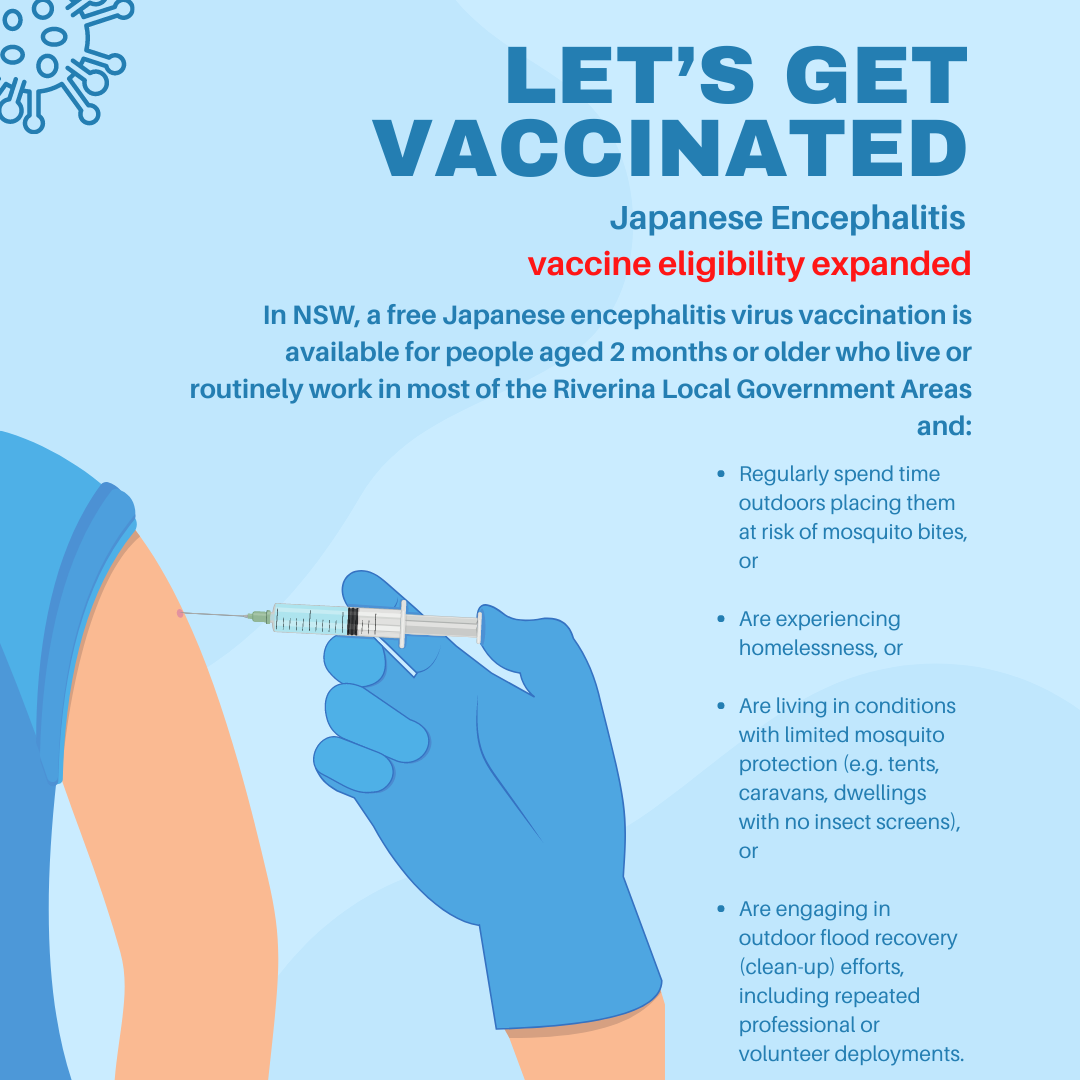
Japanese encephalitis is a rare but serious illness caused by the Japanese encephalitis virus (JEV). It is spread to humans by infected mosquitoes.
Before last year, Japanese encephalitis virus had rarely been found in Australia with previous cases noted only in Northern Australia, Cape York and the Torres Strait.
It is not known how Japanese encephalitis virus came into mainland Australia, but the movement of infected mosquitoes or migratory water birds may have played a part in the virus' spread, combined with significant rain events.
Japanese encephalitis virus has now been detected in pigs and humans in Western and Southern NSW, as well as in Queensland, Victoria, the Northern Territory and South Australia.
Not all mosquitoes in NSW carry the Japanese encephalitis virus, but some do carry JEV as well as other diseases such as Barmah Forest, Ross River and more rarely, the virus that causes Murray Valley encephalitis. The best thing you can do is take steps to prevent being bitten.
The Japanese encephalitis vaccine is safe and effective for people aged 2 months and older. Vaccination is recommended for those at the highest risk of catching Japanese encephalitis.
Once fully vaccinated, it can take between 2 to 4 weeks for your body to develop a protective immune response to the disease, so if you’re eligible, you should get vaccinated as soon as possible.
Who is eligible for a free Japanese encephalitis virus vaccination
In NSW, a free Japanese encephalitis virus vaccination is available for people aged 2 months or older who live or routinely work in any of the below Local Government Areas and:
Regularly spend time outdoors placing them at risk of mosquito bites, or
Are experiencing homelessness, or
Are living in conditions with limited mosquito protection (e.g. tents, caravans, dwellings with no insect screens), or
Are engaging in outdoor flood recovery (clean-up) efforts, including repeated professional or volunteer deployments.
LGAs of high JEV concern
Albury
Balranald
Berrigan
Bland
Bogan
Bourke
Brewarrina
Broken Hill
Carrathool
Central Darling
Cobar
Coolamon
Coonamble
Dubbo Regional
Edward River
Federation
Forbes
Gilgandra
Goulburn Mulwaree
Greater Hume
Griffith
Hay
Junee
Lachlan
Leeton
Lockhart
Moree Plains
Murray River
Murrumbidgee
Narrabri
Narrandera
Narromine
Parkes
Temora
Unincorporated Far West Area
Wagga Wagga
Walgett
Warren
Warrumbungle
Weddin
Wentworth
How to get Japanese encephalitis vaccination
If you are eligible for a free JEV vaccine, speak to your General Practitioner (GP), pharmacist or Aboriginal Medical Service about getting vaccinated today.
People who meet the above criteria should make an appointment with their GP, pharmacist or Aboriginal Medical Service and let them know it is for the Japanese encephalitis vaccine as they may require a few days' notice to order the vaccine.
Boosting Newell Highway flood mitigation south of Forbes
The Australian Government will contribute $50 million to improve flood mitigation on important sections of the Newell Highway between West Wyalong and Forbes.

The Australian Government will contribute $50 million to improve flood mitigation on important sections of the Newell Highway between West Wyalong and Forbes.
The new funding is in addition to the NSW Government’s existing $200 million commitment, bringing total project funding to $250 million.
The Australian Government funding for this project will be delivered through the Roads of Strategic Importance (ROSI) initiative, which helps connect regional businesses to local and international markets, and better connect regional communities.
This additional funding will enable well-known flooding issues on this important section of the Newell Highway to be addressed.
For more information on the project, visit nswroads.work/ww2f.
More information on the Australian Government’s ROSI initiative is available at https://investment.infrastructure.gov.au/about/national-initiatives/roads-of-strategic-importance.aspx.
ENGIE | The Plains Renewable Energy Park
The Plains Renewable Energy Park is a newly proposed large-scale development that aims to harness wind and solar energy to provide cheap, reliable and clean electricity for homes and businesses in NSW.

The Plains Renewable Energy Park is a newly proposed large-scale development that aims to harness wind and solar energy to provide cheap, reliable and clean electricity for homes and businesses in NSW. The renewable energy park will include the construction of an integrated wind and solar farm and will operate alongside agricultural activities.
Located south of Hay, The Plains is strategically positioned within the South-West Renewable Energy Zone (REZ), which was identified by the NSW Government due to the abundance of high-quality wind and solar resources, proximity to transmission infrastructure, relative land-use compatibility and a strong pipeline of potential projects.
The Plains is currently in the initial stages of consulting with local community members and conducting feasibility studies.
Key figures
Typically, renewable energy projects can take between three and seven years, from initial concept through to construction, with The Plains currently developing an initial concept
To support the transition to cleaner and cheaper energy, The Plains Renewable Energy Park aims to have a generating capacity of 400 megawatts, which is the equivalent of powering 260,000 homes
To achieve a 400 megawatt capacity, preliminary estimates indicate the development may include up to 240 wind turbine generators and approximately 600,000 to 800,000 solar panels
Wind turbines are normally up to 280 meters tall.
ENGIE have developed a short Community Benefits survey to capture feedback on what’s most important to the local community, future engagement activities and project benefits. Provide your feedback and help shape programs and initiatives that truly benefit the local community.
ABC Heywire winners celebrate stories of life across regional and rural Australia
Strength, perseverance, and optimism feature strongly in the stories from the 2023 ABC Heywire winners.

Strength, perseverance, and optimism feature strongly in the stories from the 2023 ABC Heywire winners.
Since its inception in 1998, Heywire has become a powerful platform for rural youth, putting them at the centre of the conversations that shape their communities.
Hundreds of Australians aged 16 to 22 from regional, rural and remote areas entered the competition by speaking openly and candidly about life beyond our major cities, through written stories, photos, videos or audio recordings.
From dreams of representing Australia in the Paralympics, to supporting young people living with a chronic illness, speaking up against racial discrimination, rebuilding after disaster, using art as a vessel for healing and listening and learning from country, the 39 Heywire winners' stories explore their capacity for resilience, amplify their voices and foster their ability to advocate for the issues that matter.
Heywire winner Jo is a proud sistagirl from Ngukurr, a remote Indigenous community in the Northern Territory. She wants her story to help other LGBTQIA+ young people feel less alone, "I hope it will inspire all people who have faced the same challenges as I did."
Judith Whelan, ABC Director Regional & Local, congratulated this year's competition winners on their engaging and authentic stories.
"The stories from this year's Heywire winners provide a real window into the lives of young people living in regional Australia. What is uplifting about them is that they celebrate regional communities and the things that make them unique.
"Their stories speak of the challenges of life outside our big cities but also reveal inspiring ideas on how their communities can make the most of their strengths and potential."
The Hon Kristy McBain, Minister for Regional Development, Local Government and Territories said, "I congratulate all 39 Heywire storytelling competition winners for sharing their stories, which demonstrate the great resilience of these young leaders living in Australia's regions and the adversity they've overcome."
"Heywire plays an important role in empowering young regional, rural and remote Australians to share their stories and ideas to the nation, encouraging their journeys as they continue to enact the change they want to see in our country.
“Young people are the leaders of tomorrow, which is why the Australian Government is proud to be an ongoing sponsor of the program — investing in young leaders and their ideas to ensure a strong future for regional Australia."
Advocates, pilots, LGBTQIA+ allies, Indigenous youth leaders, photographers, medical students, law students, musical theatre performers, rouseabouts, and artists are just a few examples of the winners who have worked with the ABC to produce their stories for radio and online, the results of which are available via the ABC Heywire website.
Heywire winners share individual stories specific to their lived experience of the place they call home. The experience of growing up in Lockhart River, Queensland, with 3G is different to a childhood on a farm in Wagin, Western Australia and different again to coming out at an all-boys country boarding school in Tamworth, NSW.
Because of this complexity, the 2023 winners are passionate about creating common ground. Heywire winner jack, from Tamworth, Wiradjrui Country, said: "After the past three years we need to rebuild our lives again to some normality, not alone but together."
He spent his lockdown wrestling with his identity and knows firsthand the importance of finding a safe community and feeling connected.
Charlee from Heyfield, Victoria, Gunaikurnai Country, agreed: "I want other young Australians to realise they aren't alone, that the youth of Australia have a voice." Charlee is using her voice to advocate for more support for people suffering from chronic illness in regional, rural or remote Australia. "I want others to read my story with a new perspective on chronic pain."
ABC Heywire is supported by: The Department of Infrastructure, Transport, Regional Development, Communications and the Arts; Department of Health and Aged Care; Department of Agriculture, Fisheries and Forestry; Department of Employment and Workplace Relations and AgriFutures Australia.
The Riverina region winner was Shayan, from Wagga Wagga, who stays connected to their culture by making Persian a part of their post-migration life: https://www.abc.net.au/heywire/heywire-winner-shayan-nsw/101685886
You can read the fresh perspectives of young people from right across regional, rural and remote Australia here: https://www.abc.net.au/heywire/winners/
A Migration System for Australia’s Future – Public Submissions
On 2 September 2022, the Minister for Home Affairs, the Hon. Clare O’Neil MP, announced a comprehensive review of Australia’s migration system to ensure it better meets existing challenges and sets a clear direction for the coming decades.

On 2 September 2022, the Minister for Home Affairs, the Hon. Clare O’Neil MP, announced a comprehensive review of Australia’s migration system to ensure it better meets existing challenges and sets a clear direction for the coming decades.
On 7 September 2022, the Minister appointed three eminent persons to guide a review of Australia’s migration system. This review will inform a Strategy: A Migration System for Australia’s Future (the Strategy).
On 15 November 2022, public submissions were opened on the Department of Home Affairs website, and a Discussion Paper was published to inform submissions. Submissions will close on 15 December 2022. Submissions can be lodged on A Migration System for Australia’s Future – Public Submissions.
Targeted consultations with stakeholders are anticipated to take place in late January - early February 2023 to test and refine ideas for reform.
For further information, see: A Migration System for Australia’s Future (homeaffairs.gov.au).