

NSW Government $7.7M Boost for ADHD and Behavioural Support in Regional NSW
The NSW Government will invest $7.7 million to trial a new model of care and management for children with behavioural issues including attention-deficit hyperactivity disorder (ADHD) in regional NSW.

The NSW Government will invest $7.7 million to trial a new model of care and management for children with behavioural issues including attention-deficit hyperactivity disorder (ADHD) in regional NSW.
Treasurer Dominic Perrottet said the funding would be included in the upcoming 2021-22 NSW Budget to provide greater support for families in the bush.
“This is about ensuring kids and young people across our State are able to get the help they need when challenges arise. We don’t want families to just survive, we want them to thrive and meeting health needs plays a vital part in that,” Mr Perrottet said.
Health Minister Brad Hazzard said the pilot program will give people greater access to vital services closer to home.
“We are pleased to invest in a trial that will help children and young people with behavioural issues including ADHD and their families seek the care they need in their local community,” Mr Hazzard said.
“Medical and allied health staff will be employed in regional areas to work directly with the families to help children and young people transition from school to tertiary education or work while managing their behavioural issues.”
The mixed model service will connect children and young people with behavioural management and support needs to a range of state-wide services including:
• existing diagnostic services;
• paediatric psychiatry support;
• tertiary children’s services;
• transition care and management; and
• telehealth and outreach clinics.
The trial builds on the recommendations of the Henry Review which examined the current model of care for the assessment and management of children and young people with behavioural issues including ADHD in NSW.
“We have taken on board the three recommendations of the Henry Review, and the new model of care will be informed by input from medical and allied health staff across NSW,” Mr Hazzard said.
In 2021-22, the NSW Government will contribute $1.8 million funding for the ADHD pilot program, with a total investment of $7.7 million over four years.
NSW Government Funding Boost for Aboriginal Programs, Housing and Infrastructure
The NSW Government has announced $350 million for vital Aboriginal programs to further support some of the most vulnerable people and families in the state.

The NSW Government has announced $350 million for vital Aboriginal programs to further support some of the most vulnerable people and families in the state.
Treasurer Dominic Perrottet said the 2021-22 Budget continues the $212 million funding announced last year as part of the Government’s COVID-19 recovery plan, which is already making a difference to Aboriginal peoples across the state.
“This budget is not just about dollars; it is about our commitment to ensure funding is directed to the areas where it can make the most difference for Aboriginal communities across our state,” Mr Perrottet said.
The investment of $350 million includes:
$259.6 million capital investment over four years by Aboriginal Housing Office to deliver around 250 new Aboriginal Housing dwellings across the State, and 7,000 upgrades to AHO and community owned homes.
$34.1 million in funding to expand the Roads to Home program for up to 10 additional communities based in regional NSW, over three years to ensure Aboriginal communities across NSW have access to public infrastructure and civil services many take for granted
$30 million over four years to pilot a range of social impact investments, with the first round of investments prioritised to supporting the social and economic wellbeing of women experiencing disadvantage, including young Aboriginal women
$11.6 million for the continuation of the Services Our Way (SOW) program over two years
A grant of more than $4.8 million to continue funding for the Hunter Valley’s new Madoo Museum Cultural Hub. This museum, first announced in 2020, will showcase a rich collection of local Indigenous artefacts currently stored in various sites around the region, including the relocation of the renowned Morrison Collection from the Australian Museum, as well as create jobs and skills opportunities
$4.75 million grant to the Bularri Muurlay Nyanggan Aboriginal Corporation and Wajaana Yaam Adventure Tours to develop a wide-ranging Aboriginal experience in Coffs Harbour, including developing an ecocultural tourism facility and outdoor amphitheatre
$4.4 million for the Birubi Point Aboriginal Place Tourism Transport Interchange, first announced in 2018.
Minister for Aboriginal Affairs Don Harwin said the NSW Government’s investment in this area highlights how it is listening to the community and is committed to ensuring sustainable, longer term improvement in the lives of Aboriginal people in NSW.
“All Aboriginal people should have every opportunity to build the skills to thrive. By helping to achieve Closing the Gap targets, the social impact investment will support better educational outcomes,” Mr Harwin said.
“The broad range of Aboriginal projects, initiatives and services that are funded in this budget show just how seriously we are working to provide support to Aboriginal people.”
Minister for Water, Property and Housing Melinda Pavey said the NSW Government is focused on reducing homelessness, supporting victims of family and domestic violence, and protecting vulnerable children, while also increasing the number of Aboriginal people reaching their full potential.
“The Government is investing in a range of services to reach more Aboriginal people, families and communities to disrupt the cycle of inter-generational disadvantage, which benefits everyone,” Mrs Pavey said.
“Whether it’s putting rooves over the heads of our most vulnerable, the Roads to Home Program providing better access to infrastructure and services, or SOW supporting 22 Local Government Areas with culturally appropriate and trauma-sensitive support – we are dedicated to ensuring our communities get the support they need.”
NSW to welcome back international students under pilot plan
International students are expected to be welcomed back under a NSW Government pilot plan for their safe return over the second half of the year, to help kick-start the billion-dollar industry.

International students are expected to be welcomed back under a NSW Government pilot plan for their safe return over the second half of the year, to help kick-start the billion-dollar industry.
Treasurer Dominic Perrottet said international students are a vital missing piece in the State’s economic recovery, with the sector worth $14.6 billion in 2019.
This will benefit tens of thousands of NSW residents whose jobs rely on this industry across retail, hospitality and many other fields.
The pilot plan will initially see a limited number of students from a range of countries in purpose-built student accommodation adhering to the same quarantine requirements as all incoming travellers.
“International education is our second most valuable export and we need to do what we can to help students return and revive this sector as quickly as possible,” Mr Perrottet said.
“Typically, we have more than 250,000 international students studying in NSW each year and they directly supported over 95,000 local jobs prior to the pandemic. If we don’t act fast, students will turn to other overseas destinations and it could take the sector decades to recover.
“That’s why we’ve developed a pilot plan supported by NSW Health and NSW Police that enables 250 international students to come to Sydney per fortnight from mid-year, in a gradual approach that will enable us to closely manage the process and ensure community health is not compromised.”
The international student allocation will be in addition to the current number of returning Australians allowed into NSW each week. “This won’t come at the expense of returning Aussies. We will continue to bring back 3,000 people per week – well more than any other state,” Mr. Perrottet said.
NSW Health would triage arriving students and direct them to quarantine at specially approved student accommodation at no cost to taxpayers. The first of these sites has been chosen, with contract negotiations well advanced.
It is estimated that the combined impact of closed international borders, including on students and tourism, could be as high as $1.5 billion per month for NSW. This is a major contributing factor to the CBD’s slower economic recovery rate.
“This is a crucial sector for NSW and Australia, and we will work with the Commonwealth and education sector to achieve the best outcome,” Mr Perrottet said.
Professor Barney Glover AO, on behalf of the NSW Vice-Chancellors’ Committee, welcomed the State’s approval of the Program after working collaboratively for several months to commence the safe return of international students to NSW.
“As at May this year, there were many higher education students diligently studying offshore – many of whom expect to return to our campuses to finish their studies. This Program has carefully considered the personal, social and academic aspects of our students, to ensure they successfully resume their studies and re-join NSW’s vibrant, multicultural community as soon as possible,” Professor Glover said.
“We are excited to finally welcome back international students to experience the worldclass education, training and research that makes NSW such an attractive destination for education.”
Council of International Students President, Belle Lim was extremely encouraged to learn that the NSW Plan had been submitted for review.
“We are so happy to see that international students will be welcomed back to NSW. This sends a great message to international students studying online offshore that there is hope that things will return to normal again,” Ms Lim said.
“We are pleased to see the cautious approach but are hopeful the numbers of students arriving will scale over time. CISA strongly supports the detailed planning that has been done by NSW.”
The NSW plan has been submitted to the Federal Government for final review
$36.4 Million for Mental Health Support in the regions
Treasurer Dominic Perrottet and Minister for Mental Health Bronnie Taylor recently announced a $36.4m package for Response and Recovery Specialists across regional and rural NSW will be included in the 2021-22 NSW Budget.

Regional and Rural communities facing ongoing adversity in the wake of natural disasters will have access to more mental health support than ever before.
Treasurer Dominic Perrottet and Minister for Mental Health Bronnie Taylor recently announced a $36.4m package for Response and Recovery Specialists across regional and rural NSW will be included in the 2021-22 NSW Budget.
Mr Perrottet said this announcement continues the NSW Government’s significant investment in mental health services, including a record $2.4 billion in last year’s budget.
“We know families and people have been doing it tough in these areas, facing drought, bushfires, COVID-19 and now a mice plague, and this package will offer continued mental health support to those in need,” Mr Perrottet said.
“We want to ensure people not only get help at the time of a disaster, but that it’s accessible during the recovery phase so communities can bounce back and people can rebuild lives.”
Minister for Mental Health Bronnie Taylor said 57 Response and Recovery Specialists would ensure quality services were available at all times.
“When the unprecedented drought and bushfires were crippling our state, these counsellors were there to support communities and now they’re on hand to help those affected by other disasters like the mice plague too.” Mrs Taylor said.
The Response and Recovery Specialists provide mental health counselling, coordination with local services and communities and ongoing support to individuals and their families at locations of their choosing, whether at home or in the local cafe.
“The best thing about these extra 57 mental health specialists is people don’t need to go to their GP to be referred. They can access them through the mental health line or other local services.
“What’s unique about these roles is that the people that undertake this work as counsellors are members of their communities and they can provide local insight, as well as a friendly soft entry to mental health support,” Mrs Taylor said.
“This is particularly important for people who are so used to facing significant adversity that they may hesitate to seek help when they need it.”
Appointment of Board Regional Development Australia Riverina
Regional Development Australia Riverina is excited to announce the appointment of its board from July 2021 until June 2023 following an open EOI process.

Regional Development Australia Riverina is excited to announce the appointment of its board from July 2021 until June 2023 following an open EOI process.
RDA Riverina Chair Dianna Somerville said “the independent assessor and I were pleased and very impressed with the number and calibre of applicants. This made the process extremely competitive and the decision a difficult one. “
A number of previous board members chose not to reapply and I thank them for their contribution to RDA Riverina and their service to the region.
The new board members are:
David Bardos – Business Development Manager Port of Melbourne
Christine Howard – Director Three Rivers University Department of Rural Health
Mark Hillis – Owner Wagga Caravans
Gary Lavelle – GM Temora Shire Council
Sue Molyneaux – Human Resources Manager Casella Family Brands
Christine Priest – General Manager Digital Business and Strategy Kurrajong
Andrew Reilly – Group Manager Shire Activation Leeton Shire Council
Dallas Tout – Manager Revenue & Payables Centre CSU, Deputy Mayor WWCC
Ray Willis – GM Riverina Local Land Services
The RDA Riverina team, led by CEO Rachel Whiting, has worked tirelessly to deliver insight and leadership across topics of economic development, migration, regionalisation and workforce strategy. RDA Boards play an important role in building strong, confident and vibrant regions. The focus of RDA Boards is to work with all levels of government, business and community groups to create jobs, attract investment and stimulate economic growth in their regions. RDA Boards also provide the Australian Government valuable regional intelligence to inform policy development and implementation
Regional Development Australia Boards (RDAs) have played and continue to play an important role in delivering sustainable infrastructure and services to their region. These Boards deliver important work in consulting with communities, promoting and participating in regional initiatives, and providing information and advice on their region to all levels of Government. If you would like to learn more about how RDA Riverina is able to assist you, visit its website at www.rdariverina.org.au. Further information about the RDA program is available at www.rda.gov.au
Regional Data Hub Survey
The Federal Government is calling for public input on the creation of the Regional Data Hub – a new central source of data for Australia’s regions.

We know that data is critical for making evidence-based decisions in your region. RDA Riverina has a subscription service available via REMPLAN for your ongoing data needs. We are also available for smaller one-off data projects or just to track down the public datasets that you may need. Find out more on our website.
The Federal Government is calling for public input on the creation of the Regional Data Hub – a new central source of data for Australia’s regions.
Data plays a critical role in helping community decision-makers and governments improve outcomes for Australia’s regional communities. The Regional Data Hub (the Hub) will improve the evidence base for regional communities, local leaders, and industry by bringing together key economic, demographic, and socio-economic data to provide easy access for users to information about their regions. The Hub is part of the Australian Government’s $13.7 million Better Data Use to Support Delivery for Regional Australians program, announced in the 2020-21 Budget.
If you would like to have a say in the development of the Regional Data Hub the Government is looking for feedback on:
- how you use data
- what data you need
- how you access data
- if you have data you would like to share
This information will be used to help design the data hub, what data is available, and how you can access it. A six-week consultation process is now underway to understand the data and information needs of users that will help prioritise data sets made available on the Hub.
For more information, you can read the consultation paper here: https://www.communications.gov.au/have-your-say/regional-data-hub-consultation
There are two ways to provide feedback:
1. Take the survey here
2. A written submission in response to the consultation paper here
The public consultation period closes at 5pm AEST on Friday, 2 July 2021.
2021 RDA Stakeholder Survey
The Department of Infrastructure, Transport, Regional Development and Communications (the Department) is conducting a short survey to obtain feedback about the effectiveness of the Regional Development Australia Committees (RDA) program in supporting economic development.

RDA Stakeholder Survey
The Department of Infrastructure, Transport, Regional Development and Communications (the Department) is conducting a short survey to obtain feedback about the effectiveness of the Regional Development Australia Committees (RDA) program in supporting economic development. As an RDA stakeholder, your feedback would be greatly appreciated and will be used to drive improvements in the program.
The survey is short and should only take a few minutes to complete. Please complete the survey by 22 June 2021.
RDA program is a national network of committees made up of local leaders who work with all levels of government, business, and community groups to support and broker economic development opportunities for their regions. There are 47 RDA Committees which focus on the economic development and jobs growth of their designated region. In addition, there are five capital city RDA Committees which are located in Sydney, Melbourne, Brisbane, Perth, and Adelaide.
ARTD Consultants have been engaged by the Department to survey RDA stakeholders about their experiences with the program.
If you are having any difficulties accessing the survey, please reply to this email. If you have any concerns about the legitimacy of the survey please contact the RDA program team, update@infrastructure.gov.au.

RDA Riverina shares the stories of Skilled Migrants in the Riverina
Regional Development Australia Riverina is pleased to announce the publication of a booklet of Skilled Migration Success Stories.
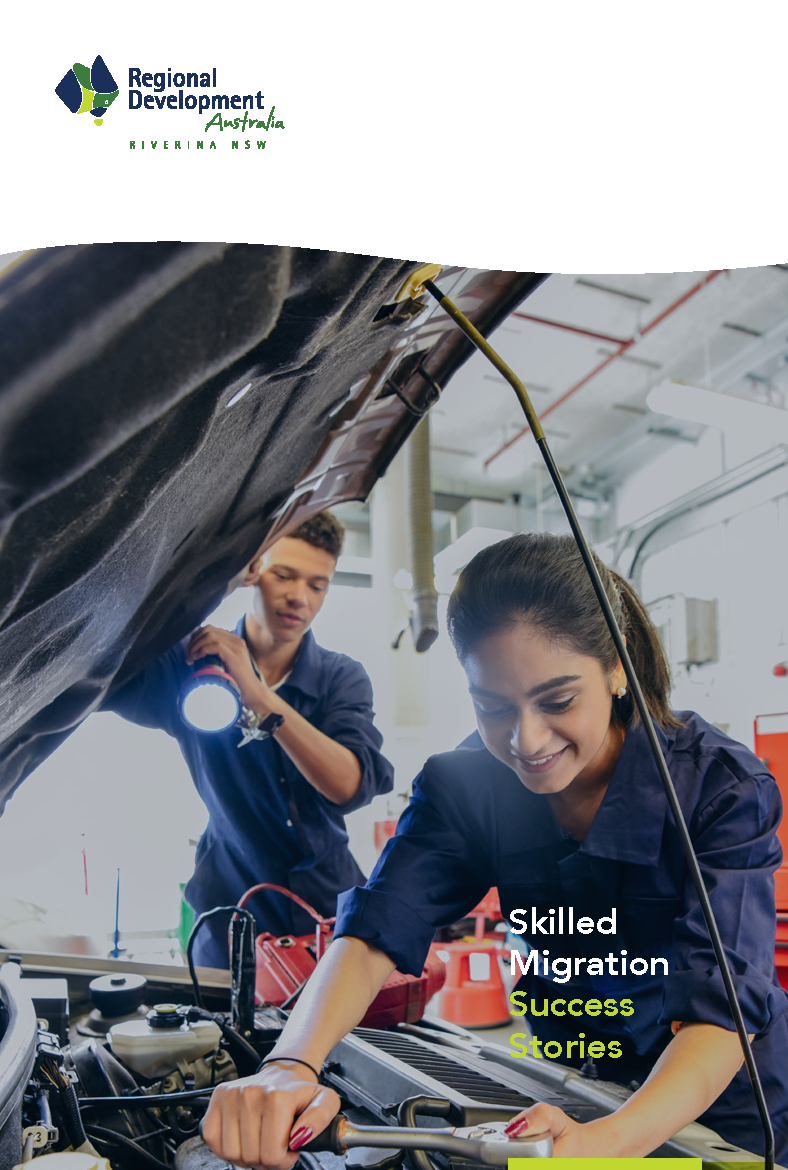
Regional Development Australia Riverina is pleased to announce the publication of a booklet of Skilled Migration Success Stories.
The booklet showcases the stories of six skilled migrants who relocated to the Riverina area as a result of the Skilled Migration nomination program administered by RDA Riverina.
Rachel Whiting, CEO, and Director of Regional Development, said:
“At RDA Riverina we recognise the importance of skilled migration in addressing business needs and filling skills gaps in our region. We have a long history of building relationships and assisting connections between skilled migrants and local industry.”
As a gazetted Regional Certifying Body (RCB), appointed by the Minister for Immigration, RDA Riverina invites skilled migrants to enjoy the lifestyle of regional Australia by applying for sponsorship to live and work in the Riverina region, filling roles affected by current skills shortages.
“Here, we showcase some of the success stories in the Riverina. Please enjoy their stories and join us in welcoming them, and future migrants to the Riverina. We also hope that these stories will help to start conversations about how we can make our communities more welcoming and embracing of new residents.” Rachel said.
Regional Development Australia Committees (RDAs) have played and continue to play an important role in delivering sustainable infrastructure and services to their region. These Committees deliver important work in consulting with communities, promoting and participating in regional initiatives, and providing information and advice on their region to all levels of Government.
2019 - 2020 RDA Riverina Annual Report published
The RDA Riverina Committee and Staff proudly present our 2019 - 2020 Annual Report.
The RDA Riverina Committee and Staff proudly present our 2019 - 2020 Annual Report.
This report covers an extremely challenging period for the Riverina region, namely the devastation of the Dunn’s Road bushfire immediately followed by the Covid-19 Pandemic. These twin crises have brought with them some opportunity as well as hardship. As such, our staff have been busier than ever responding to the needs of our community. Although the production of the report was delayed, the information within is still very pertinent. We hope you find value in this summary of RDA Riverina’s activities in the 2019 - 2020 year.

RDA Riverina 2019 - 2020 Annual Report cover image, courtesy of Louise Freckleton of Highfield Farm and Woodland, Mount Adrah.

Employing Mature Age Australians - Department of Education, Skills and Employment
Skills Think Consulting is undertaking a national project for the Australian Department of Education, Skills and Employment (DESE)

Skills Think Consulting is undertaking a national project for the Australian Department of Education, Skills and Employment (DESE)
Employers, you are being asked to contribute to research asking you, as an employer, for your views on the benefits and challenges of engaging more over-55s in your business. Older workers bring more experience, diversity and productivity, helping you get the best mix for your workforce. A 5% lift in participation among the mature aged will add an extra $48 billion extra to GDP.
You can have your say in two ways. Choose EITHER, or to be in the draw for five $200 Officeworks vouchers, BOTH!
Take a 2-minute, anonymous online poll HERE. We ask quick demographic info and five easy ‘on-a-scale’ questions.
AND, if you have time, please give more in-depth input by indicating your availability HERE for a 30-minute phone or video interview. Add your name, select three proposed timeslots, and then add your contact details. An interview guide with questions will be emailed to you beforehand, to help you gather your thoughts.
This research is commissioned by the Australian Government Department of Education, Skills and Employment and examines:
the capacity and willingness of businesses to employ older workers
perceived barriers amongst businesses to employment of this cohort
possible solutions to these barriers.
Thank you for your contribution to this important research. If you have any questions, please email the research team HERE.
TransGrid commits to delivering Australia's biggest electricity interconnector
TransGrid’s Board has announced it will build the critical electricity transmission project, EnergyConnect, which will save NSW customers $180 million a year and create 1,500 new construction jobs in regional NSW.

TransGrid commits to delivering Australia’s biggest electricity interconnector to lower electricity bills and create 1500 new construction jobs
TransGrid’s Board has announced it will build the critical electricity transmission project, EnergyConnect, which will save NSW customers $180 million a year and create 1,500 new construction jobs in regional NSW.
TransGrid CEO, Paul Italiano, confirmed the company will invest $1.834 billion to deliver the major, NSW section of EnergyConnect from Wagga Wagga in the State’s south to the South Australian border.
Mr Italiano said: “EnergyConnect is a transformational energy project which will provide net benefits of up to $11.9 billion and save NSW customers $180 million a year, or $64 annually on an average household bill.
“EnergyConnect will be Australia’s biggest electricity interconnector built to date in the National Electricity Market and it will help to accelerate Australia’s energy transition by connecting customers with more renewable generation.
“EnergyConnect will also help to abate an estimated one million tonnes of carbon emissions each year contributing significantly to meeting Australia’s climate change targets.
“Regional NSW will benefit from the creation of 1,500 construction jobs and an injection of more than $250 million in direct project expenditure.
“The project will also contribute a further $4 billion in economic activity for NSW.”
Mr Italiano thanked the South Australian Government for its unwavering support for the project, the Federal Government for the support it has provided via an underwriting agreement with South Australia and through the Clean Energy Finance Corporation (CEFC) and project delivery partner, ElectraNet, for the essential role it has played to advance the project through the regulatory process.
The TransGrid Board’s investment decision came after it was able to partially resolve financeability issues for EnergyConnect, which challenge delivery of major regulated transmission projects in the NEM.
This has been achieved via an agreement between TransGrid and the CEFC on the issue of an innovative $295 million hybrid debt instrument.
Mr Italiano said: “The agreement with the CEFC has been essential to the Board’s final investment decision today and we are thankful to the Corporation for working with us to progress this important project.”
CEFC CEO Ian Learmonth said: “It is significant that the largest single investment the CEFC has made since we began investing will help deliver more renewable energy to Australian consumers by adding such a substantial piece of infrastructure to our electricity grid. We are proud that CEFC finance is supporting this important investment in the grid.
Work on EnergyConnect is expected to commence by the end of 2021.
Have your say on the Future Drought Fund
The Future Drought Fund is calling for primary producers, community representatives and ag innovators’ input into the Drought Resilience Research and Adoption Investment Plan.

The Future Drought Fund is calling for primary producers, community representatives, and ag innovators’ input into the Drought Resilience Research and Adoption Investment Plan.
We need your help to identify research and adoption priorities for regional and national drought resilience under the Australian Government’s $5 billion Future Drought Fund.
If you’re a primary producer, community representative or ag innovator, please keep reading to Have Your Say.
About the Future Drought Fund
The $5 billion Future Drought Fund will help primary producers and rural and regional communities become more prepared for, and resilient to, future droughts.
The Fund’s Research and Adoption Program will provide $117.3 million up to 2023-24 to support drought resilience and innovation activities.
The Program has four interconnected elements: Adoption and Innovation Hubs, Innovation Grants, a Science to Practice Forum and a national Drought Resilience Research and Adoption Investment Plan.
The Investment Plan will identify national and regional research and adoption priorities and help to shape the Future Drought Fund’s future investments.
Your voice needed to help guide the Drought Resilience Research and Adoption Investment Plan
We want producer, community and innovation providers’ voices to be heard at all stages of the Program.
That’s why we’ve partnered with Alluvium Consulting Australia to engage as widely as possible with rural and regional stakeholders. Please take the survey and/or register for a workshop to have your say on regional and rural research and adoption investment priorities ahead of future droughts.
Business NSW 2021 Workforce Skills survey
We know that businesses across NSW are facing challenges to find the right staff.
This is why Business NSW is conducting the 2021 Workforce Skills Survey to understand those challenges.

Together we can take action on the skills crisis.
We know that businesses across NSW are facing challenges to find the right staff.
This is why Business NSW is conducting the 2021 Workforce Skills Survey to understand those challenges.
Your responses will help them advocate for improvements to the skills sector in NSW and across Australia in the post-COVID recovery.
The survey will take between 10 to 15 minutes to complete.
Griffith University | Australian Silo Art Research Project Survey
This Griffith University Research Project (GU Ref: 2020/824) is exploring the social and economic impacts of Australian silo art on both (i) visitors and (ii) people who live in and around towns with silo art, such as Weethalle.
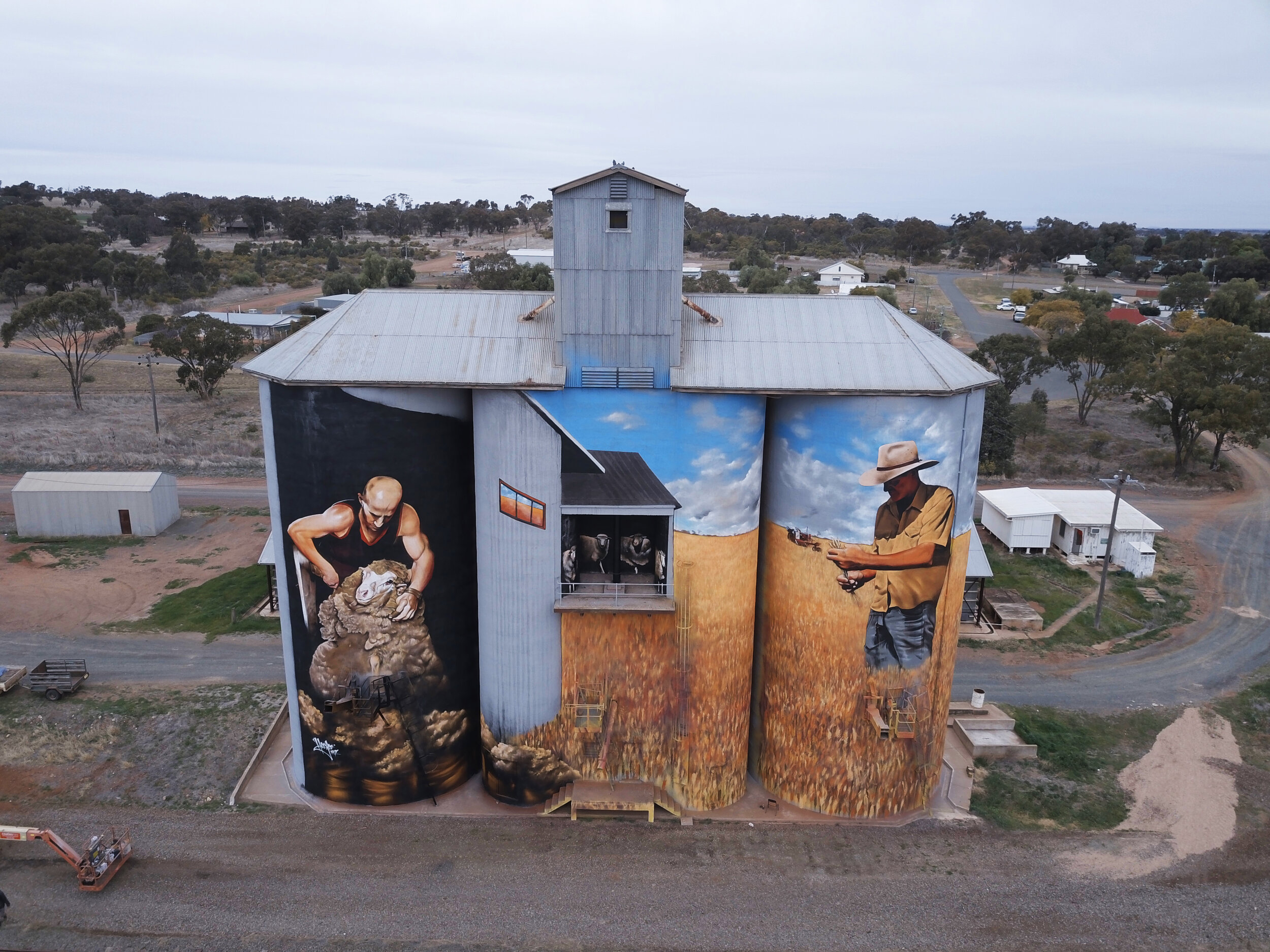
This Griffith University Research Project (GU Ref: 2020/824) is exploring the social and economic impacts of Australian silo art on both (i) visitors and (ii) people who live in and around towns with silo art, such as Weethalle.
The findings of this research will provide much-needed publicly available and empirical evidence regarding the current impacts of silo art as a growing national movement. The knowledge gained will also help to support and shape future mural, public art, cultural and tourism projects throughout rural and regional Australia, including the ongoing promotion, activation and extension of existing silo art sites.
The first public report from this research will be available in July.
This project involves two online surveys:
#1) The ‘main survey’ (approx. 20 minutes) for both (i) silo art visitors and (ii) local communities in towns with silo art; and
#2) A shorter business survey (approx. 5 minutes) for business owners/managers based within 100km of a silo art site.
The business survey is intended for a range of businesses (including those that have not experienced any impacts associated with silo art).
New Holiday Here This Year campaign iteration launched
Tourism Australia’s latest iteration of the Holiday Here This Year campaign was launched earlier this month, again fronted by iconic Aussie couple Hamish Blake and Zoe Foster-Blake.

Tourism Australia’s latest iteration of the Holiday Here This Year campaign was launched earlier this month, again fronted by iconic Aussie couple Hamish Blake and Zoe Foster-Blake.
They explore some of the incredible “big” experiences around Australia, all internationally reliant tourism regions, to encourage domestic audiences to start taking those longer trips and travel like international consumers do.
A new, interactive holiday quiz has also been rolled out to help consumers choose their next big adventure.
Industry is encouraged to participate in and benefit from the domestic campaign activity by:
Downloading the Holiday Here This Year toolkit, which is available for download from the corporate website. The toolkit contains a campaign overview, campaign logos, city specific imagery for use in your own channels and social media tools.
Aligning your marketing activity to support the campaign.
Post on your business social media channels to encourage consumers to book using #HolidayHereThisYear and the Holiday Here This Year giphy stickers.
Share your news and activities with Tourism Australia for consideration to promote through our PR activities. Please send to internationalmedia@tourism.australia.com.
NSW Interpreter Scholarship Program
Applications are now open for people who speak new and emerging and in-demand languages to receive scholarships to become qualified practicing interpreters.

NSW Interpreter Scholarship Program – Applications Open Now
Applications are now open for people who speak new and emerging and in-demand languages to receive scholarships to become qualified practicing interpreters.
People speaking any of the following languages are encouraged to apply:
Acholi, Bari, Chin (Tedim), Chinese (Hakka), Dinka, Ewe, Fijian, Fullah, Hakka (Timorese), Hmong, Karen, Kayah, Khmer, Kirundi, Krio, Malayalam, Mongolian, Mun (Chin), Nuer, Oromo, Samoan, Somali, Tetum, Tibetan, Tigrinya and Tongan.
Recipients will benefit from subsidised training at TAFE NSW and the University of NSW and course graduates will be eligible to become Recognised Practicing Interpreters with the National Accreditation Authority for Translators and Interpreters (NAATI).
Expressions of interest are open until 9 June 2021. Visit the website for more information.
Business Connect evaluation survey
NSW Treasury is seeking feedback about the Business Connect program.

NSW Treasury is seeking feedback about the Business Connect program.
What’s this about?
NSW Treasury is conducting an evaluation of the program and looking at how the NSW Government can support small businesses in future.
They are seeking feedback from Business Connect customers, NSW small businesses, industry organisations and other stakeholders on the services provided by Business Connect.
About Business Connect
Business Connect is a dedicated and personalised NSW Government program that provides trusted advice to help small businesses start, run, adapt or grow.
Over 120 Business Connect advisors offer advice tailored to your needs.
Business Connect advisors are accredited professionals with first-hand experience running their own small business. Their advice is independent and completely confidential.
Business Connect provides hundreds of business events and resources including live and on demand webinars, online workshops, fact sheets and training videos to complement advisory sessions.
Since 2017, over 39,000 businesses have been supported through Business Connect to date.
Have your say
Please complete the survey to tell them what you think of the Business Connect program.
The survey should take approximately 10 minutes.
Have your say by Monday 24 May 2021.
National Economic Development Awards for Excellence 2021
Entries in the 2021 National Economic Development Awards for Excellence are Now Open

Entries in the 2021 National Economic Development Awards for Excellence are Now Open
Economic Development Australia (EDA) invites you to enter the National Economic Development Awards for Excellence. Preparing a submission is simple and winning a prestigious EDA award is a great way to shine a spotlight on your innovative economic development projects and raise the profile of your work. Submissions can be made for projects delivered from 1 January 2019 – 30 June 2021.
Winners will be announced at a gala event during the National Economic Development Conference (NEDC22) in Mackay, QLD on October 14 2021.
Submissions close on Friday 16th July 2021 at 5pm AEST.
2021 Award Categories
1. Economic Development Strategic Thinking
This award recognises best practice strategies where economic development outcomes are the leading factors and basis influencing the approach adopted. EDA is looking for areas such as employment / workforce / investment / industrial and commercial development.
2. Economic Development Marketing and Promotion
Marketing and promotion is a vital skill for many economic development practitioners. Submissions should describe the whole process of their project from the planning stage through to implementation. Success is not measured by the size or budget of a campaign but the effectiveness of the methods and approach adopted. This award is ideal to present your winning regional branding and / or tourism marketing strategies and campaigns using innovative content development tactics.
3. Economic Development Through Partnerships and Collaboration
This award recognises excellence in economic development through meaningful collaboration and partnerships. Submissions should demonstrate economic outcomes realised through a clustering or
collaborative approach. Please note: It is advised that a paid consultancy is not considered a partnership.
4. Economic Development Initiatives – Regions Under 15,000 Residents
This award recognises programs or projects that have stimulated economic development activity in smaller regions. Examples may include retaining and growing existing businesses, boosting investment, raising employment opportunities and more. EDA encourages submissions which articulate the goals and the outcomes achieved, highlighting how the outcomes contributed to economic development in the region.
5. Economic Development Initiatives – Regions Over 15,000 Residents
This award recognises programs or projects that have stimulated economic development activity in larger regions. Examples may include retaining and growing existing businesses, boosting investment, raising employment opportunities and more. Submissions should describe the goals set and the outcomes achieved, highlighting how the outcomes contributed to economic development in the region
6. Economic Development Recovery & Resilience
This award recognises successful economic development programs, initiatives or activities implemented following a disaster, crises or economic downturn. This award also recognises economic development programs which are focussed on resilience building and mitigation.
7. Economic Development Equity, Diversity & Inclusion
This award recognises economic development strategies and projects which foster equity, diversity and inclusion. EDA welcomes projects where the community’s cultural, religious, linguistic and ethnic diversity underpin the economic development strategy and / or project. Other examples may be centred around gender diversity and / or supporting greater economic participation for young people.
8. Economic Development – Sustainable Initiatives
This award recognises best practice economic development initiatives delivering positive environmental and social outcomes. EDA is seeking submissions where circular economy and sustainability principles underpin economic development strategies and / or projects.
HONORARY CATEGORIES
9. The Peter Chaffey Economic Development Leadership Award (Economic Development Practitioner – over 30 years old)
This award recognises an individual who has demonstrated exemplary performance in the economic development profession. Successful nominations will have had a significant impact on revitalising communities, and will have been at the forefront of developing and delivering projects that drive innovation and change. They will have played a major role in shaping and improving the practice of economic development. Nominations must not exceed 1,000 words (typed double spaced pages) and should be accompanied by at least one (not more than three) letters of endorsement which should be no more than two pages and must be submitted in conjunction with the application. Nominations for the award must be a member of EDA and endorsed by an EDA member.
10. Economic Development Rising Star Leadership (Economic Development Practitioner – up to 30 years old)
This award recognises outstanding achievement by a young, emerging leader in the economic development profession. Nominations should detail the significant career achievements to date and the impact of those achievements on the organisation and the community as a whole, and also explain how these achievements have contributed to the advancement of economic development as a profession. Nominations for the award must be endorsed by an EDA member and will recognise not just their contribution to economic development but their level of community involvement. Nominations should be accompanied by a minimum of one, and not more than three, letters of endorsement on behalf of the applicant, from their supervisor, board chair, or other significant leader in the community who is actively involved with the applicant’s organisation. Nominations must not exceed 1,000 words (typed double spaced pages); letters of endorsement should be no more than two pages and must be submitted in conjunction with the application. Applicants must be no more than 30 years of age on the deadline submission date. Their date of birth must be noted on their application. Nominees must be a member of EDA.
11. Economic Development Community Champion Award
This award recognises an individual who has displayed dedication and commitment to his/her community as a leader and advocate for economic development. They will have demonstrated sustained and effective efforts to work with community groups and industry leaders in the development of projects as a business leader, elected official or volunteer. Nominations for the award must be endorsed by an EDA member but the nominee does not need to be a member of EDA to be eligible to receive this award.
SEGRA | Searching for Regional Success Stories
The SEGRA National Steering Committee is calling for papers for SEGRA 2021 being held in Kalgoorlie Boulder 16-18 November. Submissions close on 4 June 2021.
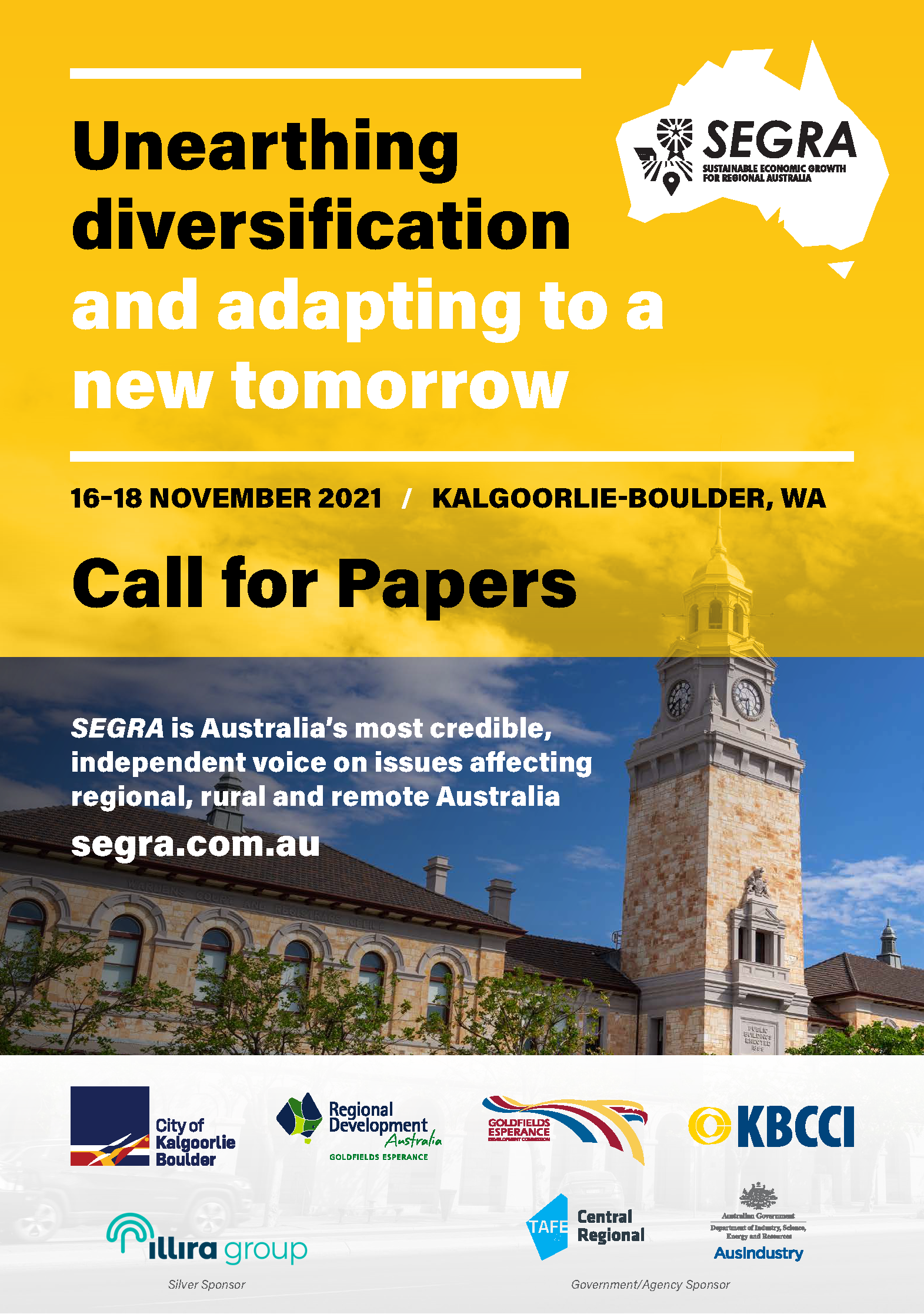
The SEGRA National Steering Committee is calling for papers for SEGRA 2021 being held in Kalgoorlie Boulder 16-18 November. Submissions close on 4 June 2021.
SEGRA is recognised as Australia’s most credible, independent voice on issues affecting regional, rural and remote Australia. SEGRA brings together practitioners, government, business, not for profit and researchers to source and identify the techniques, skills and issues they need to address to achieve successful economic growth and development.
To find out more about SEGRA visit here
The theme for this year’s conference is:
Unearthing diversification and adapting to a new tomorrow
Diversification is an important way in which businesses or regions can expand or develop and increase their economic strength and capacity.
Identifying regional opportunities for diversification is a key economic development strategy and is a priority action now more than ever before. Emerging technology, data optimisation and automation are all driving industries not previously envisioned.
Regions are often well placed with large green field sites, potential for independent energy, and a propensity for innovation to embrace diversification.
Regions enable diversification by identifying, promoting and providing opportunities to participate in emerging product markets; working to ensure appropriate infrastructure and freight logistics; tapping into supporting practices that will encourage businesses to strengthen their capabilities and expand or shift to new activities through information dissemination and communication.
The Action Agendas for the conference are:
If you, or region or your business is doing something exciting in regional, rural and remote share it at SEGRA 2021. The Call for Papers flyer can be viewed here.
Skills shortages take a bite out of regional towns
RDA Riverina’s CEO Rachel Whiting and Regional Australia Institute’s Chief Economist Kim Houghton spoke to ABC Life Matters’ Michael Mackenzie about Skills Shortages in our regions.

RDA Riverina’s CEO Rachel Whiting and Regional Australia Institute’s Chief Economist Kim Houghton spoke to Michael Mackenzie from ABC’s Life Matters about skills shortages in our regions.
Listen to the discussion at ABC Life Matters